This time, a senior scientist has kicked over the beehive and created a minor furore. Professor Nigel French FRS, Director of the New Zealand Food Safety Science and Research Centre, has stated in an interview that he would not drink raw milk, nor give it to his family.
In my opinion, he is correct in stating that even the most careful production of raw milk cannot avoid some contamination by cow faeces, which, of course, contain bacteria and viruses. Some of these bacteria and viruses can cause serious human disease. As a microbiologist, I am fully aware of the sensitivity of microbiological testing and can confirm Prof. French's comment that bacteria can still be present, even if the test shows negative.
Scrupulous cleanliness and attention to detail can reduce the chances of faecal contamination of the milk, but cannot eliminate the risk. Since the beginning of the year, there have been two recalls of raw milk over fears of contamination by Campylobacter, a bacterium that can cause diarrhoea (frequently bloody), abdominal pain, fever, headache, nausea, and/or vomiting. Occasionally, it can produce more serious symptoms requiring hospitalisation.
Reading the comments on the article, it is clear that the proponents of raw milk consumption will not be swayed by scientific facts, and it is their right to drink raw milk. However, the New Zealand
Prime Minister's Chief Science Advisor Dr Peter Gluckman concluded: "The
claimed health benefits of raw milk compared with pasteurised milk are
for the most part not backed by scientific evidence, making the
risk-benefit ratio very high for this food product ..."
I have written about the hazards of drinking raw milk before (see the label Raw Milk) and the latest recalls simply confirm my opinion. Many of the people commenting on the report are saying that they grew up drinking raw milk without problems. What they appear not to appreciate is that our lifestyle has changed. We don't collect our milk daily; children are coddled and protected from exposure to bacteria by the use of antibacterial soaps and cleansers, they don't go out to play in the dirt and often they are not exposed to farm animals. In my opinion, their immune systems are less robust. At the very least, children should not be fed raw milk - they have no ability to refuse it.
The regulations surrounding sale of raw milk have been tightened considerably, including labelling and warnings on bottles. Raw milk cannot be sold from health food stores and use-by dates must be printed on the packaging. It is interesting to note that sales of raw milk are not permitted in Australia.
Showing posts with label Campylobacter. Show all posts
Showing posts with label Campylobacter. Show all posts
Friday, March 9, 2018


Sunday, January 7, 2018
Raw water: Is it bullshit?
There is a new fad spreading rapidly in the US. "Raw water" is the latest craze for health fanatics keen to spend serious money.
What is raw water? Its proponents claim it is water as nature intended it - unfiltered and untreated, containing minerals from the water source and no chlorine. One raw water company claims that "all other bottled, filtered, tap, and even spring waters are sterilised with ozone gas, irradiated with UV light, and passed through a submicron filter" and that "blasting water with ozone changes its molecular structure". Clearly, there is some truth in this statement, but also a lot of nonsense.
Some water sources are indeed safe to consume untreated; others may appear to be so, but are not safe. In August 2016, over 1000 residents of Havelock North in New Zealand became ill after consuming drinking water from two bores operated by the local council. Investigations showed that the affected residents had been infected by Campylobacter. This was not the first time that the bore heads had been found to be contaminated. The outcome of an extensive investigation was that the water in the bore heads was contaminated with water from an adjoining farm pond on land that had been inundated by heavy rains. The aquifer was not contained and when the pumps were turned on, water from the pond, probably contaminated with sheep faeces, was drawn into the town supply. Anecdotal evidence says that the level in the pond dropped when the pumps were turned on. An immediate response was to chlorinate all water supplied in the area, which annoyed some residents, and the two affected bores were closed. Water was drawn from other bores in the nearby Hastings area and the supply has been chlorinated.
I am constantly surprised by people who want to turn back the clock to a time when food and water borne diseases were common, before modern scientific and technological advances made our lives much safer. Campaigning to ban chlorination of town water is one of those issues. Consumption of raw milk is another one of those desires that can lead to illness.
However, I am also reminded constantly that many rural areas are not serviced by mains water and wastes are treated on site in septic tanks, then discharged to the land. Our house on our own lifestyle farm collects water from the roof and stores it in 36,000L tanks. There is no filtration, chemical or UV treatment. We, like many other rural dwellers, are thereby deliberately exposing ourselves to risk, though there is no alternative other than boiling water or buying bottled water for drinking. The only thing I can say is that since moving to the farm over 30 years ago, we have never suffered from gastrointestinal illness.
Where does this leave us? Treated tap water is probably the safest water supply. Experience shows that rural tank water is usually safe, though it is not sterile; provided that the tanks are protected from contamination by animals or from septic tanks, there is little to fear from drinking it. The perceived benefits of bottled raw water may be illusory, and the marketing hype criticising filtration and ultraviolet treatment of spring waters is just plain misleading. Those getting the most benefit from bottled raw water are the suppliers.
What is raw water? Its proponents claim it is water as nature intended it - unfiltered and untreated, containing minerals from the water source and no chlorine. One raw water company claims that "all other bottled, filtered, tap, and even spring waters are sterilised with ozone gas, irradiated with UV light, and passed through a submicron filter" and that "blasting water with ozone changes its molecular structure". Clearly, there is some truth in this statement, but also a lot of nonsense.
Some water sources are indeed safe to consume untreated; others may appear to be so, but are not safe. In August 2016, over 1000 residents of Havelock North in New Zealand became ill after consuming drinking water from two bores operated by the local council. Investigations showed that the affected residents had been infected by Campylobacter. This was not the first time that the bore heads had been found to be contaminated. The outcome of an extensive investigation was that the water in the bore heads was contaminated with water from an adjoining farm pond on land that had been inundated by heavy rains. The aquifer was not contained and when the pumps were turned on, water from the pond, probably contaminated with sheep faeces, was drawn into the town supply. Anecdotal evidence says that the level in the pond dropped when the pumps were turned on. An immediate response was to chlorinate all water supplied in the area, which annoyed some residents, and the two affected bores were closed. Water was drawn from other bores in the nearby Hastings area and the supply has been chlorinated.
I am constantly surprised by people who want to turn back the clock to a time when food and water borne diseases were common, before modern scientific and technological advances made our lives much safer. Campaigning to ban chlorination of town water is one of those issues. Consumption of raw milk is another one of those desires that can lead to illness.
However, I am also reminded constantly that many rural areas are not serviced by mains water and wastes are treated on site in septic tanks, then discharged to the land. Our house on our own lifestyle farm collects water from the roof and stores it in 36,000L tanks. There is no filtration, chemical or UV treatment. We, like many other rural dwellers, are thereby deliberately exposing ourselves to risk, though there is no alternative other than boiling water or buying bottled water for drinking. The only thing I can say is that since moving to the farm over 30 years ago, we have never suffered from gastrointestinal illness.
Where does this leave us? Treated tap water is probably the safest water supply. Experience shows that rural tank water is usually safe, though it is not sterile; provided that the tanks are protected from contamination by animals or from septic tanks, there is little to fear from drinking it. The perceived benefits of bottled raw water may be illusory, and the marketing hype criticising filtration and ultraviolet treatment of spring waters is just plain misleading. Those getting the most benefit from bottled raw water are the suppliers.
Saturday, July 27, 2013
Raw milk linked with food poisoning in New Zealand
I have written several times about the hazards of drinking raw milk (see the label "raw milk"). Using Ministry of Health information obtained under the Official Information Act, Talia Shadwell has written about food poisoning linked with consumption of raw milk in the Manawatu and Waikato, two regions of New Zealand.
A total of nine people, including two young children, were hospitalised in March, suffering from Escherichia coli infection. A month later, six people contracted campylobacteriosis. A common factor in all these cases was apparently consumption of raw milk.
What is of great concern to me is that these patients revealed that they had little knowledge of the hazards of drinking raw milk, despite the publicity given to such outbreaks.
I would uphold the right of individuals to consume raw foods if they so wish, but they should be fully aware of the risks and remember that their children do not really have the luxury of food choice.
A total of nine people, including two young children, were hospitalised in March, suffering from Escherichia coli infection. A month later, six people contracted campylobacteriosis. A common factor in all these cases was apparently consumption of raw milk.
What is of great concern to me is that these patients revealed that they had little knowledge of the hazards of drinking raw milk, despite the publicity given to such outbreaks.
I would uphold the right of individuals to consume raw foods if they so wish, but they should be fully aware of the risks and remember that their children do not really have the luxury of food choice.
Wednesday, April 18, 2012
How much does Joe Sixpack know about food safety?
Recently, we ran a small competition for attendees at a public food expo. They had to enter answers to questions on food safety knowledge set by a computer. The machine stored the answers and we drew a prize from those who got them all right. Incidentally, we used this as an educational opportunity by giving immediate feedback on the answers entered.
Though the survey was not statistically valid, I analysed the responses. The results were largely unsurprising - approximately 65 to 75 percent of responses were correct for most questions.
However, a third of respondents didn't know which food poisoning bacterium (Campylobacter) causes the most food poisoning in New Zealand, despite extensive coverage in the news media over the past two years. A third also incorrectly identified pesticide residues as more important than packaging failure in causing human foodborne disease, and again, a third thought that it was illegal to sell food past its "best before" date. Only a quarter of respondents knew that it is legal to sell raw milk in New Zealand.
It was pleasing to see that 97 percent of respondents knew that refrigeration would not stop the growth of all bacteria in food, and 80 percent understood that irradiation is not a means for unscrupulous manufacturers to make spoiled food appear fresh.
Of more concern was the belief by 80 percent of respondents that chicken can be regarded as cooked if the juice runs clear when the thigh meat is pricked, and 28 percent of respondents thought that if it were safe to eat a rare steak, it was also safe to eat hamburger rare.
It seems that we still have some way to go in educating our population about safe food handling and consumption.
Though the survey was not statistically valid, I analysed the responses. The results were largely unsurprising - approximately 65 to 75 percent of responses were correct for most questions.
However, a third of respondents didn't know which food poisoning bacterium (Campylobacter) causes the most food poisoning in New Zealand, despite extensive coverage in the news media over the past two years. A third also incorrectly identified pesticide residues as more important than packaging failure in causing human foodborne disease, and again, a third thought that it was illegal to sell food past its "best before" date. Only a quarter of respondents knew that it is legal to sell raw milk in New Zealand.
It was pleasing to see that 97 percent of respondents knew that refrigeration would not stop the growth of all bacteria in food, and 80 percent understood that irradiation is not a means for unscrupulous manufacturers to make spoiled food appear fresh.
Of more concern was the belief by 80 percent of respondents that chicken can be regarded as cooked if the juice runs clear when the thigh meat is pricked, and 28 percent of respondents thought that if it were safe to eat a rare steak, it was also safe to eat hamburger rare.
It seems that we still have some way to go in educating our population about safe food handling and consumption.
Friday, July 8, 2011
Mud hoppers
This post is not directly about food, but it is about eating stuff.
Over the last weekend, an annual event was run (well actually, quite a bit of it was crawled) over a 6km course in Auckland. Nothing unusual about cross country running in New Zealand, but this one involved obstacles to crawl under or climb over and a very large amount of mud. Two TV news presenters took part, so there was plenty of footage to analyse.

I am all for active sports, but I wonder how many of the competitors will regret the weekend's activities, and not just for sore muscles. At one point, the competitors crawled, sploshed or "swam" though a trench full of thick mud. At least one competitor dived headfirst into the mud as if he were diving into the surf. None of the participants could have avoided getting some of the mud in their mouths.
Soil is interesting stuff - it's the goto place for microbiologists if they need to isolate a microorganism that has a particular characteristic; it's one of the best sources of bacteria. If animals have been grazed on the paddock, or water in the mud has drained from a farm, it is likely that the mud will contain many faecal organisms. In 2008, there was a significant outbreak of campylobacteriosis after a mountain bike race, in which competitors got very muddy. None of the support crews became ill.
I'm sure that mud running allows us to relive our childhood without being scolded for getting dirty and it's certainly a good spectator sport, but competitors should be aware of the risks associated with eating the stuff.
Over the last weekend, an annual event was run (well actually, quite a bit of it was crawled) over a 6km course in Auckland. Nothing unusual about cross country running in New Zealand, but this one involved obstacles to crawl under or climb over and a very large amount of mud. Two TV news presenters took part, so there was plenty of footage to analyse.

I am all for active sports, but I wonder how many of the competitors will regret the weekend's activities, and not just for sore muscles. At one point, the competitors crawled, sploshed or "swam" though a trench full of thick mud. At least one competitor dived headfirst into the mud as if he were diving into the surf. None of the participants could have avoided getting some of the mud in their mouths.
Soil is interesting stuff - it's the goto place for microbiologists if they need to isolate a microorganism that has a particular characteristic; it's one of the best sources of bacteria. If animals have been grazed on the paddock, or water in the mud has drained from a farm, it is likely that the mud will contain many faecal organisms. In 2008, there was a significant outbreak of campylobacteriosis after a mountain bike race, in which competitors got very muddy. None of the support crews became ill.
I'm sure that mud running allows us to relive our childhood without being scolded for getting dirty and it's certainly a good spectator sport, but competitors should be aware of the risks associated with eating the stuff.
Saturday, August 23, 2008
Exercise viewed from the relative safety of the couch
We are constantly urged to get out and do some exercise. This can be as simple as walking to work or doing a workout in the gym. However, walking at this time of the year in New Zealand has the distinct disadvantage that you can arrive at work looking like a drowned cat. The gym is less of a problem in that respect, but just pumping iron or running on a treadmill can get mighty boring.
What about mountain or cross-country biking? That can get your heart rate up and can be very exciting. There can also be a downside. Campylobacter.
There, I bet you immediately thought “What has mountain biking got to do with chilled chicken?” Certainly, we have heard a lot about Campylobacter and chicken meat over the last couple of years, much of it not good news. But this piece is not about transmission in poultry.
On July 5th and 6th this year, a mountain bike marathon was run on Builth Wells, Wales. The two-day event attracted 947 participants, up to 160 of whom became ill after the event. The conditions were very muddy and the course was contaminated with “sheep slurry”. The result was that contaminated mud splashed over the riders and their gear. An investigation* revealed that accidental ingestion of mud was the most statistically significant risk factor. Consumption of energy drinks and energy bars from feed stations was also associated with infection. It is easy to see how these factors might be linked – riders covered in mud would contaminate their drink bottles and dirty hands could transfer mud to food. Only the competitors became ill – support crew and visitors were not involved.
The running of this type of event over muddy agricultural land makes it almost inevitable that competitors would be exposed to zoonotic infectious agents, such as Campylobacter, Salmonella and Listeria.
It is very tempting to ask whether the high incidence of campylobacteriosis in new Zealand could be at least partly explained by our passion for strenuous outdoor sports that involve getting muddy and the high proportion of the country given over to farming. We already have some data on risk factors in New Zealand see http://foodsafetywithjaybee.blogspot.com/2008/04/what-interests-you-most.html
Perhaps it would be worth including questions in the surveys about contact with mud and activities such as cross country running or rugby.
* Griffiths, S. et al (2008) Preliminary report of the epidemiological investigation into the outbreak of diarrhoeal illness in Mountain Bike Marathon participants, Builth Wells. National Public Health Service for Wales
What about mountain or cross-country biking? That can get your heart rate up and can be very exciting. There can also be a downside. Campylobacter.
There, I bet you immediately thought “What has mountain biking got to do with chilled chicken?” Certainly, we have heard a lot about Campylobacter and chicken meat over the last couple of years, much of it not good news. But this piece is not about transmission in poultry.
On July 5th and 6th this year, a mountain bike marathon was run on Builth Wells, Wales. The two-day event attracted 947 participants, up to 160 of whom became ill after the event. The conditions were very muddy and the course was contaminated with “sheep slurry”. The result was that contaminated mud splashed over the riders and their gear. An investigation* revealed that accidental ingestion of mud was the most statistically significant risk factor. Consumption of energy drinks and energy bars from feed stations was also associated with infection. It is easy to see how these factors might be linked – riders covered in mud would contaminate their drink bottles and dirty hands could transfer mud to food. Only the competitors became ill – support crew and visitors were not involved.
The running of this type of event over muddy agricultural land makes it almost inevitable that competitors would be exposed to zoonotic infectious agents, such as Campylobacter, Salmonella and Listeria.
It is very tempting to ask whether the high incidence of campylobacteriosis in new Zealand could be at least partly explained by our passion for strenuous outdoor sports that involve getting muddy and the high proportion of the country given over to farming. We already have some data on risk factors in New Zealand see http://foodsafetywithjaybee.blogspot.com/2008/04/what-interests-you-most.html
Perhaps it would be worth including questions in the surveys about contact with mud and activities such as cross country running or rugby.
* Griffiths, S. et al (2008) Preliminary report of the epidemiological investigation into the outbreak of diarrhoeal illness in Mountain Bike Marathon participants, Builth Wells. National Public Health Service for Wales
Thursday, June 5, 2008
It had to happen!
In the USA, the argument about raw milk still rages. We now see the spectacle of lawyers claiming that consumers are being deprived of their rights to choose their food, while others sue the suppliers for selling dangerous milk.
The raw milk lobby claims that pasteurization robs the milk of its nutritional value and the natural enzymes that help the human digestive system. I am not aware of any scientific evidence to support this. They also vociferously claim that pasteurization kills the “good bacteria”. The zealous consumers claim that their rights are being trampled if they are prevented from buying the product. The regulators point to the dangers of consuming raw milk, such as the diseases caused by Salmonella, Campylobacter, Escherichia coli, Listeria and others, a point conveniently ignored by the raw milk proponents.
The hazards of consuming raw milk have been known for a long time. In Ontario around 1900, over 10% of all childhood tuberculosis was thought to be caused by unpasteurized milk. The rate of tuberculosis infection and many other milk-borne diseases in children fell dramatically after enactment of a law in 1938 requiring milk to be pasteurized; this was hailed as a major achievement.
The fact is that between 1998 and 2005, a total of 45 outbreaks resulting in more than 1,000 illnesses, 104 hospitalizations and two deaths due to raw milk or soft raw milk cheese were reported to the Centres for Disease Control and Prevention. There have been more recent, high-profile cases. Pathogens were found in 13 percent of bulk tank raw milk samples by a survey of Pennsylvania dairy farms in 2006. In California, 2008, new regulations set a limit of 10 coliforms per millilitre of raw milk. Raw milk suppliers maintain that the regulation will put them out of business, which suggests to me that they feel unable to meet this specification. But it's the same standard used for pasteurized milk. <For an explanation of the use of coliforms, see "Is hamburger a greater risk for E. coli" this blog, posted 3rd May 2008>.
Farmers who are selling raw milk are able to charge a significant premium for their product and understandably wish to continue supply. However, nothing comes without a price, and the right to sell a particular food product imposes certain responsibilities. Some American consumers have contracted serious disease from drinking raw milk. Unfortunately, children have no choice in the source of their milk and several have suffered haemolytic uremic syndrome (which has a 90% mortality rate without treament) and a number have required kidney transplants. The suppliers are now being sued.
In New Zealand, NZFSA has recently renewed its warning to consumers about raw milk cheeses, which have recently been approved for sale here. People with compromised immune systems, the elderly or pregnant women are urged to avoid these products.
The raw milk lobby claims that pasteurization robs the milk of its nutritional value and the natural enzymes that help the human digestive system. I am not aware of any scientific evidence to support this. They also vociferously claim that pasteurization kills the “good bacteria”. The zealous consumers claim that their rights are being trampled if they are prevented from buying the product. The regulators point to the dangers of consuming raw milk, such as the diseases caused by Salmonella, Campylobacter, Escherichia coli, Listeria and others, a point conveniently ignored by the raw milk proponents.
The hazards of consuming raw milk have been known for a long time. In Ontario around 1900, over 10% of all childhood tuberculosis was thought to be caused by unpasteurized milk. The rate of tuberculosis infection and many other milk-borne diseases in children fell dramatically after enactment of a law in 1938 requiring milk to be pasteurized; this was hailed as a major achievement.
The fact is that between 1998 and 2005, a total of 45 outbreaks resulting in more than 1,000 illnesses, 104 hospitalizations and two deaths due to raw milk or soft raw milk cheese were reported to the Centres for Disease Control and Prevention. There have been more recent, high-profile cases. Pathogens were found in 13 percent of bulk tank raw milk samples by a survey of Pennsylvania dairy farms in 2006. In California, 2008, new regulations set a limit of 10 coliforms per millilitre of raw milk. Raw milk suppliers maintain that the regulation will put them out of business, which suggests to me that they feel unable to meet this specification. But it's the same standard used for pasteurized milk. <For an explanation of the use of coliforms, see "Is hamburger a greater risk for E. coli" this blog, posted 3rd May 2008>.
Farmers who are selling raw milk are able to charge a significant premium for their product and understandably wish to continue supply. However, nothing comes without a price, and the right to sell a particular food product imposes certain responsibilities. Some American consumers have contracted serious disease from drinking raw milk. Unfortunately, children have no choice in the source of their milk and several have suffered haemolytic uremic syndrome (which has a 90% mortality rate without treament) and a number have required kidney transplants. The suppliers are now being sued.
In New Zealand, NZFSA has recently renewed its warning to consumers about raw milk cheeses, which have recently been approved for sale here. People with compromised immune systems, the elderly or pregnant women are urged to avoid these products.
Monday, April 21, 2008
What interests you most?
My Sitemeter collects statistics on usage of this blog (don’t worry, you can’t be identified) including pages visited and referrals from search engines like Google and Yahoo.
I looked through some recent stats and found that the most common questions referred to the safety of chicken (by far the most frequent referral), unpasteurized milk, coliforms and how bacteria can get into food. There were one or two surprising enquiries, but I won’t go into those.
Over the next few posts I’ll visit some of the more popular questions, starting with a report from New Zealand on campylobacteriosis and poultry.
The March 2008 Monthly Surveillance Report from ESR makes for interesting reading. http://www.surv.esr.cri.nz/surveillance/monthly_surveillance.php?
we_objectID=1548
The incidence of campylobacteriosis in the human population of New Zealand has fallen again. 450 campylobacteriosis cases were notified in March 2008 compared with 1145 cases notified in the same month of the previous year. The current 12 month rate* is 234 cases per 100,000 head of population, compared with 386 for the previous 12 months to March 2007 – a 39% reduction. Compared with the rates of other infectious diseases surveyed, this is a very significant achievement.
Though there is currently no direct evidence, at least some of this reduction must be because of the strenuous efforts made by the poultry industry to reduce the levels of contamination on fresh poultry and poultry products.
The Campylobacter surveillance data contain other interesting observations on the possible source of infection: of the cases where the information was recorded, 51% had eaten food from a food premise (I assume that means a restaurant or take-away); 38% had contact with farm animals; 22% had contact with other people showing symptoms of campylobacteriosis. Other possible links included pre-schools and childcare, drinking non-habitual or untreated water supply or contact with recreational water. A surprising 17% reported faecal contact, while a small proportion reported contact with a sick animal.
Obviously, this information is confounded and incomplete and doesn’t explain exactly how the patients contracted campylobacteriosis. However, it does point to the special nature of life in New Zealand and suggests that we need to look widely to find ways to control our high incidence of campylobacteriosis.
using the keyword Campylobacter, or go to "So what is this Campylobacter thing?" posted Tuesday 21st November 2006 by clicking the Archive).
How do you know chicken is safe to eat? If you cook it yourself, use a meat thermometer to check the internal temperature reaches 74 C (165 F). The USDA suggests 160 F (71.1 C) for beef burgers. If you buy chicken ready-cooked for reheating, use the same temperatures. If you are going to eat pre-cooked chicken without further heating, make sure you trust the supplier.
* The 12 month rate is based on the cumulative total for the current year (12 months up to and including March 2008), expressed as cases per 100,000
I looked through some recent stats and found that the most common questions referred to the safety of chicken (by far the most frequent referral), unpasteurized milk, coliforms and how bacteria can get into food. There were one or two surprising enquiries, but I won’t go into those.
Over the next few posts I’ll visit some of the more popular questions, starting with a report from New Zealand on campylobacteriosis and poultry.
The March 2008 Monthly Surveillance Report from ESR makes for interesting reading. http://www.surv.esr.cri.nz/surveillance/monthly_surveillance.php?
we_objectID=1548
The incidence of campylobacteriosis in the human population of New Zealand has fallen again. 450 campylobacteriosis cases were notified in March 2008 compared with 1145 cases notified in the same month of the previous year. The current 12 month rate* is 234 cases per 100,000 head of population, compared with 386 for the previous 12 months to March 2007 – a 39% reduction. Compared with the rates of other infectious diseases surveyed, this is a very significant achievement.
Though there is currently no direct evidence, at least some of this reduction must be because of the strenuous efforts made by the poultry industry to reduce the levels of contamination on fresh poultry and poultry products.
The Campylobacter surveillance data contain other interesting observations on the possible source of infection: of the cases where the information was recorded, 51% had eaten food from a food premise (I assume that means a restaurant or take-away); 38% had contact with farm animals; 22% had contact with other people showing symptoms of campylobacteriosis. Other possible links included pre-schools and childcare, drinking non-habitual or untreated water supply or contact with recreational water. A surprising 17% reported faecal contact, while a small proportion reported contact with a sick animal.
Obviously, this information is confounded and incomplete and doesn’t explain exactly how the patients contracted campylobacteriosis. However, it does point to the special nature of life in New Zealand and suggests that we need to look widely to find ways to control our high incidence of campylobacteriosis.
How do you know chicken is safe to eat? If you cook it yourself, use a meat thermometer to check the internal temperature reaches 74 C (165 F). The USDA suggests 160 F (71.1 C) for beef burgers. If you buy chicken ready-cooked for reheating, use the same temperatures. If you are going to eat pre-cooked chicken without further heating, make sure you trust the supplier.
* The 12 month rate is based on the cumulative total for the current year (12 months up to and including March 2008), expressed as cases per 100,000
Friday, March 28, 2008
The news just keeps on getting worse!
After so many years of living with a food microbiologist, my wife has become a valuable food retail spy. Today she told me two more horror stories:
In our local supermarket there is a display stand for unwrapped bakery goods that extends from about chest height down to the floor. The store manager has supplied tongs for customers to use and there are signs asking customers to use the tongs.
Today she arrived at the bakery counter in time to see a mother wrestling the tongs from her toddler. If this were not bad enough, the mother then said to the toddler “I thought you said you were going to eat that”. Grabbing a bun from the child’s other hand, she stuck it back in the cabinet. Now both of them had handled the bun.
Now, I realise that bread buns are not a particularly good growth medium for food poisoning bacteria, but this is unacceptable. Some food borne pathogens have a very low infecting dose. The display cabinet should be arranged so that products and tongs are inaccessible to toddlers. Owners of self-service food displays need to be aware that simply providing tongs does not guarantee the safety of the food they sell. Needless to say, we will not purchase unwrapped goods from that store again.
The second incident was observed on TVNZ’s Good Morning show. Unfortunately, I didn’t see it and have not been able to locate a replay on their website. It appears that The Mad Butcher was on the show and demonstrating the preparation of chicken. After handling the raw chicken, he put his fingers into some spices and tasted a pinch. The bowl of spices was thus contaminated with whatever bacteria were on the raw chicken. A short while later, he put a cooked chicken onto the same chopping board, contaminating it with raw poultry juices.
OK – the Mad Butcher is not a professional chef and neither is Steve Grey, the host for that segment. The poultry industry in New Zealand has had a bad press recently over Campylobacter food poisoning, allegedly transmitted largely via chicken (though in fact we have seen a significant and sustained reduction over the last year in the incidence of the disease in the human population). This sort of example on daytime television, which is probably watched by many young mothers, is perhaps one of the reasons that we see such a high incidence of campylobacteriosis in New Zealand. Young adults are not getting the food safety message and we need to have good kitchen habits shown on our national television channels. We can’t rely on the food suppliers to take total responsibility for control of food poisoning.
This type of poor kitchen practice is not confined to New Zealand; Doug Powell at Kansas State University, who runs the Food Safety Net and writes the Barfblog has castigated some TV chefs in the USA for similar indiscretions (see for example: http://barfblog.foodsafety.ksu.edu/tags/tv/).
In our local supermarket there is a display stand for unwrapped bakery goods that extends from about chest height down to the floor. The store manager has supplied tongs for customers to use and there are signs asking customers to use the tongs.
Today she arrived at the bakery counter in time to see a mother wrestling the tongs from her toddler. If this were not bad enough, the mother then said to the toddler “I thought you said you were going to eat that”. Grabbing a bun from the child’s other hand, she stuck it back in the cabinet. Now both of them had handled the bun.
Now, I realise that bread buns are not a particularly good growth medium for food poisoning bacteria, but this is unacceptable. Some food borne pathogens have a very low infecting dose. The display cabinet should be arranged so that products and tongs are inaccessible to toddlers. Owners of self-service food displays need to be aware that simply providing tongs does not guarantee the safety of the food they sell. Needless to say, we will not purchase unwrapped goods from that store again.
The second incident was observed on TVNZ’s Good Morning show. Unfortunately, I didn’t see it and have not been able to locate a replay on their website. It appears that The Mad Butcher was on the show and demonstrating the preparation of chicken. After handling the raw chicken, he put his fingers into some spices and tasted a pinch. The bowl of spices was thus contaminated with whatever bacteria were on the raw chicken. A short while later, he put a cooked chicken onto the same chopping board, contaminating it with raw poultry juices.
OK – the Mad Butcher is not a professional chef and neither is Steve Grey, the host for that segment. The poultry industry in New Zealand has had a bad press recently over Campylobacter food poisoning, allegedly transmitted largely via chicken (though in fact we have seen a significant and sustained reduction over the last year in the incidence of the disease in the human population). This sort of example on daytime television, which is probably watched by many young mothers, is perhaps one of the reasons that we see such a high incidence of campylobacteriosis in New Zealand. Young adults are not getting the food safety message and we need to have good kitchen habits shown on our national television channels. We can’t rely on the food suppliers to take total responsibility for control of food poisoning.
This type of poor kitchen practice is not confined to New Zealand; Doug Powell at Kansas State University, who runs the Food Safety Net and writes the Barfblog has castigated some TV chefs in the USA for similar indiscretions (see for example: http://barfblog.foodsafety.ksu.edu/tags/tv/).

Sunday, February 10, 2008
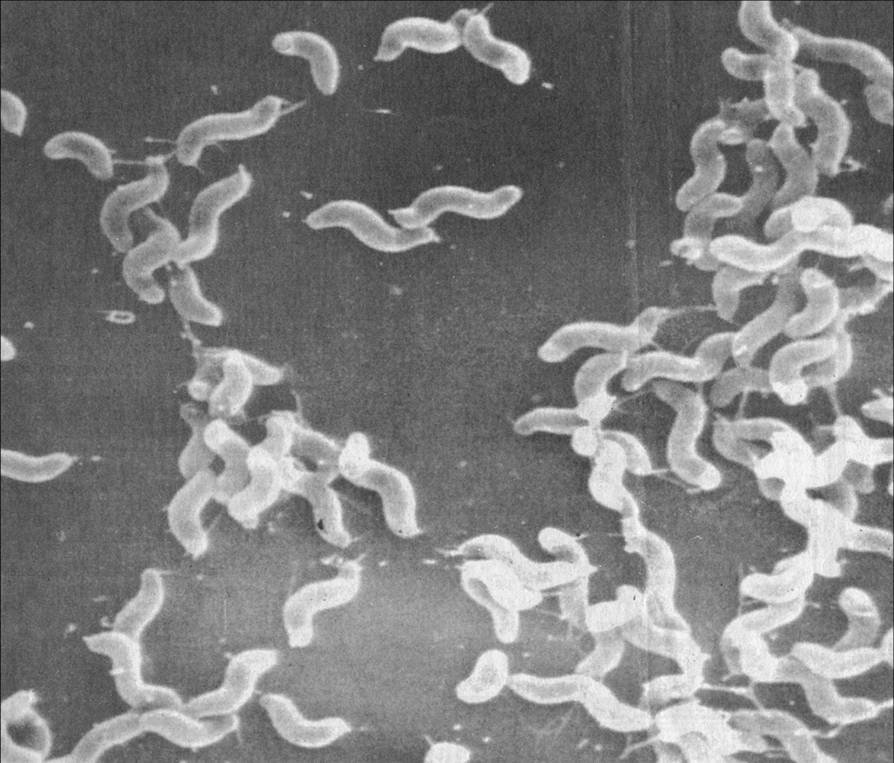
Campylobacter jejuni - SEM image

Scanning electron microscope image of Campylobacter jejuni, illustrating its corkscrew appearance and bipolar flagella. Source: Virginia-Maryland Regional College of Veterinary Medicine, Blacksburg, Virginia.
Saturday, February 9, 2008
That Campylobacter problem – it just doesn’t go away
It has been fascinating to watch the news reports, both here in New Zealand and overseas, over the last few weeks and see the different takes. The New Zealand Food Safety Authority announced on 15th January the introduction of a Code of Practice for the poultry industry. The code is intended to reduce the incidence of campylobacteriosis in New Zealand, which is the highest in the developed world. The code has received mixed reviews and the language used has at times been intemperate. The blame for much of this disease has been laid at the door of the poultry industry as suppliers of “New Zealand’s cheap and dirty food”. In a Radio NZ interview, Dr. Mike Baker claimed that when chicken is prepared in a kitchen, every surface in the kitchen will be covered with bacteria and the aprons of workers in restaurant kitchens will potentially be covered in a layer of Campylobacter.
When interviewed by the Taranaki Daily News, a Tegel spokesman said that the Company fully supported the new code. Sharon Wagener of NZFSA says that the code formalises a lot of what was already happening voluntarily in the industry. However, on the Green Party website their spokesman Sue Kedgley claimed that the code “fails to include some very simple measures to stem the tide of Campylobacter contamination of chicken meat being sold to New Zealanders”. Some of the points raised by Ms. Kedgley in relation to problems of mechanical handling and leaky packaging are not in dispute, but are already being addressed by the industry.
The Taranaki Medical Officer of Health, Richard Hoskins, noted that the Health Board has had interactions with Tegel (which of course is not the only chicken processor in the country) in efforts to reduce the incidence of the disease. He apparently expressed the view that the Board was "pretty impressed with the efforts they are going to".
Michael Brooks, the Executive Director of the Poultry Industry Association of New Zealand, has also stated that based on figures collected by ESR, human campylobacteriosis case rates have been steadily declining since August 2006, in some months showing a drop of 30-35% over the corresponding previous year. Of course, this does not satisfy everyone; the incidence of campylobacteriosis tends to be somewhat variable from month to month and it will require proper statistical analysis over some years to demonstrate a true decrease.
The adversarial approach being taken by some of the interested parties is not, in my view, the best way forward. Nobody has the complete right answer; where has the still small voice of reason and collaboration gone? Wouldn’t it be better if the parties worked together, using scientifically demonstrable facts and not overheated opinion to put together the jigsaw puzzle and solve the problem?
The fact is that human infection by Campylobacter is a very complex problem and simply pointing the finger at the poultry industry will not solve it, no matter what codes of practice are imposed. Take just one point: sub-typing of Campylobacter, using molecular methods, can show the relatedness of various isolates from poultry and from humans. In some parts of the country, a single sub-type is found in up to 20% of human cases and in poultry. In other parts, the sub-typing shows that human cases do not share the same types as found in poultry. Nobody is claiming that poultry does not contribute significantly to campylobacteriosis in New Zealand, but the industry takes this seriously and is doing something about it, having issued its own Broiler Growing Biosecurity Manual in consultation with NZFSA in August 2007. This describes the minimum standards to be used in NZ broiler production systems, aiming at ensuring the products meet food safety and suitability requirements and consumer needs. Campylobacter is a commensal bacterium – it is found in poultry and some other animals and does not cause them to be ill, so getting rid of it is going to require considerable effort and some cost on the part of farmers and processors.
The code comes into force on the first of March 2008.
For more information on Campylobacter, click here
When interviewed by the Taranaki Daily News, a Tegel spokesman said that the Company fully supported the new code. Sharon Wagener of NZFSA says that the code formalises a lot of what was already happening voluntarily in the industry. However, on the Green Party website their spokesman Sue Kedgley claimed that the code “fails to include some very simple measures to stem the tide of Campylobacter contamination of chicken meat being sold to New Zealanders”. Some of the points raised by Ms. Kedgley in relation to problems of mechanical handling and leaky packaging are not in dispute, but are already being addressed by the industry.
The Taranaki Medical Officer of Health, Richard Hoskins, noted that the Health Board has had interactions with Tegel (which of course is not the only chicken processor in the country) in efforts to reduce the incidence of the disease. He apparently expressed the view that the Board was "pretty impressed with the efforts they
Michael Brooks, the Executive Director of the Poultry Industry Association of New Zealand, has also stated that based on figures collected by ESR, human campylobacteriosis case rates have been steadily declining since August 2006, in some months showing a drop of 30-35% over the corresponding previous year. Of course, this does not satisfy everyone; the incidence of campylobacteriosis tends to be somewhat variable from month to month and it will require proper statistical analysis over some years to demonstrate a true decrease.
The adversarial approach being taken by some of the interested parties is not, in my view, the best way forward. Nobody has the complete right answer; where has the still small voice of reason and collaboration gone? Wouldn’t it be better if the parties worked together, using scientifically demonstrable facts and not overheated opinion to put together the jigsaw puzzle and solve the problem?
The fact is that human infection by Campylobacter is a very complex problem and simply pointing the finger at the poultry industry will not solve it, no matter what codes of practice are imposed. Take just one point: sub-typing of Campylobacter, using molecular methods, can show the relatedness of various isolates from poultry and from humans. In some parts of the country, a single sub-type is found in up to 20% of human cases and in poultry. In other parts, the sub-typing shows that human cases do not share the same types as found in poultry. Nobody is claiming that poultry does not contribute significantly to campylobacteriosis in New Zealand, but the industry takes this seriously and is doing something about it, having issued its own Broiler Growing Biosecurity Manual in consultation with NZFSA in August 2007. This describes the minimum standards to be used in NZ broiler production systems, aiming at ensuring the products meet food safety and suitability requirements and consumer needs. Campylobacter is a commensal bacterium – it is found in poultry and some other animals and does not cause them to be ill, so getting rid of it is going to require considerable effort and some cost on the part of farmers and processors.
The code comes into force on the first of March 2008.
For more information on Campylobacter, click here
Saturday, August 11, 2007
For the second time of asking: "Should I eat the chicken?"
The still small voice of reason is now being heard and concrete steps are being taken to understand and reduce the problem, which is not unique to New Zealand*. The New Zealand Food Safety Authority is studying possible control measures. Researchers at
So does that mean that campylobacteriosis in New Zealand is under control? I don’t think so. I believe that it is highly unlikely that Campylobacter can be eradicated in poultry, at least in the short term. There are also other sources of the bacteria in our food supply and in the environment. Only a couple of weeks ago, a number of mountain bikers taking part in a contest became ill with campylobacteriosis. No food source could be identified as the source; infected surface water and mud, which had covered the competitors as they splashed through the puddles, was blamed as the source.
Distributors, wholesalers and retailers, together with the consumers themselves, must take some responsibility for the safety of food. Even though campylobacteriosis has been shown to be linked with consumption of undercooked barbecued chicken, I am not convinced that
Should we eat the chicken? You bet!
* Work conducted in Hong Kong by my team showed that between 50 and 60% of fresh chicken was contaminated with Campylobacter. This dropped to about 30% if the poultry had been frozen. These rates of contamination are entirely consistent with figures reported for other countries.
Wednesday, November 22, 2006

Tuesday, November 21, 2006
So what is this Campylobacter thing?
Campylobacters are spiral-shaped bacteria (see picture above). They can infect both humans and animals, including birds. About 99% of the Campylobacter infections of humans are caused by just one species - Campylobacter jejuni. The micro-organisms appear to grow well in birds, which have a slightly higher body temperature than humans. Though chickens are often carriers, they show no symptoms of infection, so it's not possible to tell that the bird is infected without doing microbiological testing. C. jejuni does not grow below about 30C, so the presence of high numbers on chicken are unlikely to be the result of temperature abuse.
In humans the disease usually takes the form of abdominal pain and diarrhoea, which may contain blood, fever (typical of the body response to an infection), and vomitting may also occur. The symptoms usually last for about a week and usually no special medical intervention is required, but sometimes the patient requires hospitalization. There are some potential long-term consequences of infection - arthritis or Guillain-Barré Syndrome may follow infection. This is an auto-immune disease caused by the body's own defence system being triggered to attack the nerves. The incidence of Guillain-Barré Syndrome is estimated to be about 1 per 1000 cases.
Human infection is probably caused mainly by handling raw poultry, though the organisms may also be carried by farm animals and can be found in water supplies that have been contaminated by farm run-off. Though consumption of undercooked poultry has been suggested as a cause, in my opinion cross contamination in the kitchen (see "Should I eat the chicken?") is more likely.
The bacterium is easy to destroy by cooking. It cannot tolerate drying and can be killed by oxygen, so microbiologists have to take special precautions to handle and culture it - we grow Campylobacter in special containers where we can reduce the amount of oxygen present, replacing oxygen with carbon dioxide.
In humans the disease usually takes the form of abdominal pain and diarrhoea, which may contain blood, fever (typical of the body response to an infection), and vomitting may also occur. The symptoms usually last for about a week and usually no special medical intervention is required, but sometimes the patient requires hospitalization. There are some potential long-term consequences of infection - arthritis or Guillain-Barré Syndrome may follow infection. This is an auto-immune disease caused by the body's own defence system being triggered to attack the nerves. The incidence of Guillain-Barré Syndrome is estimated to be about 1 per 1000 cases.
Human infection is probably caused mainly by handling raw poultry, though the organisms may also be carried by farm animals and can be found in water supplies that have been contaminated by farm run-off. Though consumption of undercooked poultry has been suggested as a cause, in my opinion cross contamination in the kitchen (see "Should I eat the chicken?") is more likely.
The bacterium is easy to destroy by cooking. It cannot tolerate drying and can be killed by oxygen, so microbiologists have to take special precautions to handle and culture it - we grow Campylobacter in special containers where we can reduce the amount of oxygen present, replacing oxygen with carbon dioxide.
Friday, November 17, 2006
Should I eat the chicken?
A recent publication in New Zealand caused a lot of interest by claiming that sale of raw chicken should be banned, in favour of frozen chicken. The basis for the claim was that chicken meat is routinely contaminated with Campylobacter. The freezing process would kill the Campylobacter and render the meat safe.
Was this claim justified?
First we need to understand something about chicken farming, chicken processing and, not least, Campylobacter.
Let's start with Campylobacter. Campylobacter is a bacterium commonly found in animals and the environment. It can get into food via many different contamination vectors (carriers), including untreated water, birds, insects and animals. It is often found in the farm environment, which may be contaminated by animals.
The number of Campylobacter we need to eat to become infected is very low; various estimates put the "infecting dose" at between 6 and 800 cells. This means that even low levels of contamination in food can cause a disease if the food is consumed. Even contact with infected animals, for example in petting zoos, can put sufficient bacteria onto the fingers to give an infecting dose if they are put into the mouth (a problem with little children) or used to prepare food without first washing them carefully.
"But surely" you are asking "we cook chicken before we eat it". Well, yes we do. Assuming that we cook it properly, the Campylobacter cells will be killed and the chicken is safe to eat. But supposing that we handle the raw chicken and then prepare a salad; or we use the same chopping board to prepare the raw meat and then cut the salad on the same board, using the same knife? If we don't wash and sanitize the knife and board, we can "cross contaminate" the food from the chicken, via the knife and board.
The suggestion that raw chicken should be banned, and only frozen chicken sold now has some attraction. "Freezing kills Campylobacter, so that will make the chicken safe and we won't get cross contamination, right?" Well, it goes some way to reducing the contamination. But, as with most things to do with bacteria, it's not black and white. Again, estimates vary; freezing may destroy tens of millions of Campylobacter, but equally may have little effect. FAO/WHO data suggest a hundred-fold reduction if the product is frozen and held for a minimum of 3 weeks. A reduction of a hundred-fold sounds a lot, but in microbiological terms this might still leave millions of bacteria on the product. And as we have seen, this is plenty to give an infecting dose.
So, to go back to the title of this posting, should we eat the chicken? My personal opinion is a qualified "Yes". The caveat is that we must make sure to handle the raw chicken safely, preventing cross contamination of utensils, surfaces and other foods in the kitchen. Cook the meat properly and prevent recontamination.
The New Zealand Food Safety Authority (NZFSA) says that two of the most important ways of keeping food safe are to follow the 4Cs rule – Clean, Cook, Cover and Chill the food. Also follow the 20+20 hand wash rule before and after handling poultry and preparing food - wash your hands, using plenty of soap and warm water for at least 20 seconds, paying careful attention to finger nails and the webs between fingers. Rinse well and dry them for a further 20 seconds, using a clean dry hand towel or disposable paper towel. It has been shown that wet hands can transfer microbial contamination to utensils, refrigerator door handles, taps and other potential cross contamination points, so the drying is just as important as the washing.
Odd Spot: On 3 December 1988, Edwina Currie, the outspoken junior health minister in the UK Thatcher government was quoted as telling ITN, "Most of the egg production in this country sadly is now infected with salmonella." Sales of eggs plummeted 60 per cent overnight. The loss of revenue forced farmers to slaughter four million hens and 400 million unsaleable eggs had to be destroyed. The government had to provide a multi million pound rescue package for the poultry industry and the unfortunate Ms. Currie resigned on the 17th December. Undoubtedly, there was some substance to her claims. Vaccination of hens to protect against salmonella has now greatly reduced the levels of egg contamination to the present 0.3% reported by the latest FSA survey and since 1997 the incidence of salmonellosis in UK has fallen by a factor of about 4x. However, there is still a concern that eggs on sale in UK may contain Salmonella Enteritidis organisms, perhaps as a result of importation of eggs produced by unvaccinated hens.
Perhaps Edwina was right. Only time will tell if the advocates of frozen chicken are right too.
Was this claim justified?
First we need to understand something about chicken farming, chicken processing and, not least, Campylobacter.
Let's start with Campylobacter. Campylobacter is a bacterium commonly found in animals and the environment. It can get into food via many different contamination vectors (carriers), including untreated water, birds, insects and animals. It is often found in the farm environment, which may be contaminated by animals.
The number of Campylobacter we need to eat to become infected is very low; various estimates put the "infecting dose" at between 6 and 800 cells. This means that even low levels of contamination in food can cause a disease if the food is consumed. Even contact with infected animals, for example in petting zoos, can put sufficient bacteria onto the fingers to give an infecting dose if they are put into the mouth (a problem with little children) or used to prepare food without first washing them carefully.
"But surely" you are asking "we cook chicken before we eat it". Well, yes we do. Assuming that we cook it properly, the Campylobacter cells will be killed and the chicken is safe to eat. But supposing that we handle the raw chicken and then prepare a salad; or we use the same chopping board to prepare the raw meat and then cut the salad on the same board, using the same knife? If we don't wash and sanitize the knife and board, we can "cross contaminate" the food from the chicken, via the knife and board.
The suggestion that raw chicken should be banned, and only frozen chicken sold now has some attraction. "Freezing kills Campylobacter, so that will make the chicken safe and we won't get cross contamination, right?" Well, it goes some way to reducing the contamination. But, as with most things to do with bacteria, it's not black and white. Again, estimates vary; freezing may destroy tens of millions of Campylobacter, but equally may have little effect. FAO/WHO data suggest a hundred-fold reduction if the product is frozen and held for a minimum of 3 weeks. A reduction of a hundred-fold sounds a lot, but in microbiological terms this might still leave millions of bacteria on the product. And as we have seen, this is plenty to give an infecting dose.
So, to go back to the title of this posting, should we eat the chicken? My personal opinion is a qualified "Yes". The caveat is that we must make sure to handle the raw chicken safely, preventing cross contamination of utensils, surfaces and other foods in the kitchen. Cook the meat properly and prevent recontamination.
The New Zealand Food Safety Authority (NZFSA) says that two of the most important ways of keeping food safe are to follow the 4Cs rule – Clean, Cook, Cover and Chill the food. Also follow the 20+20 hand wash rule before and after handling poultry and preparing food - wash your hands, using plenty of soap and warm water for at least 20 seconds, paying careful attention to finger nails and the webs between fingers. Rinse well and dry them for a further 20 seconds, using a clean dry hand towel or disposable paper towel. It has been shown that wet hands can transfer microbial contamination to utensils, refrigerator door handles, taps and other potential cross contamination points, so the drying is just as important as the washing.
Odd Spot: On 3 December 1988, Edwina Currie, the outspoken junior health minister in the UK Thatcher government was quoted as telling ITN, "Most of the egg production in this country sadly is now infected with salmonella." Sales of eggs plummeted 60 per cent overnight. The loss of revenue forced farmers to slaughter four million hens and 400 million unsaleable eggs had to be destroyed. The government had to provide a multi million pound rescue package for the poultry industry and the unfortunate Ms. Currie resigned on the 17th December. Undoubtedly, there was some substance to her claims. Vaccination of hens to protect against salmonella has now greatly reduced the levels of egg contamination to the present 0.3% reported by the latest FSA survey and since 1997 the incidence of salmonellosis in UK has fallen by a factor of about 4x. However, there is still a concern that eggs on sale in UK may contain Salmonella Enteritidis organisms, perhaps as a result of importation of eggs produced by unvaccinated hens.
Perhaps Edwina was right. Only time will tell if the advocates of frozen chicken are right too.
Subscribe to:
Posts (Atom)


 Posts
Posts


